
Tag Archives: research

Collaborative Learning in Agentic Systems: A Collective AI is Greater Than the Sum of Its Parts

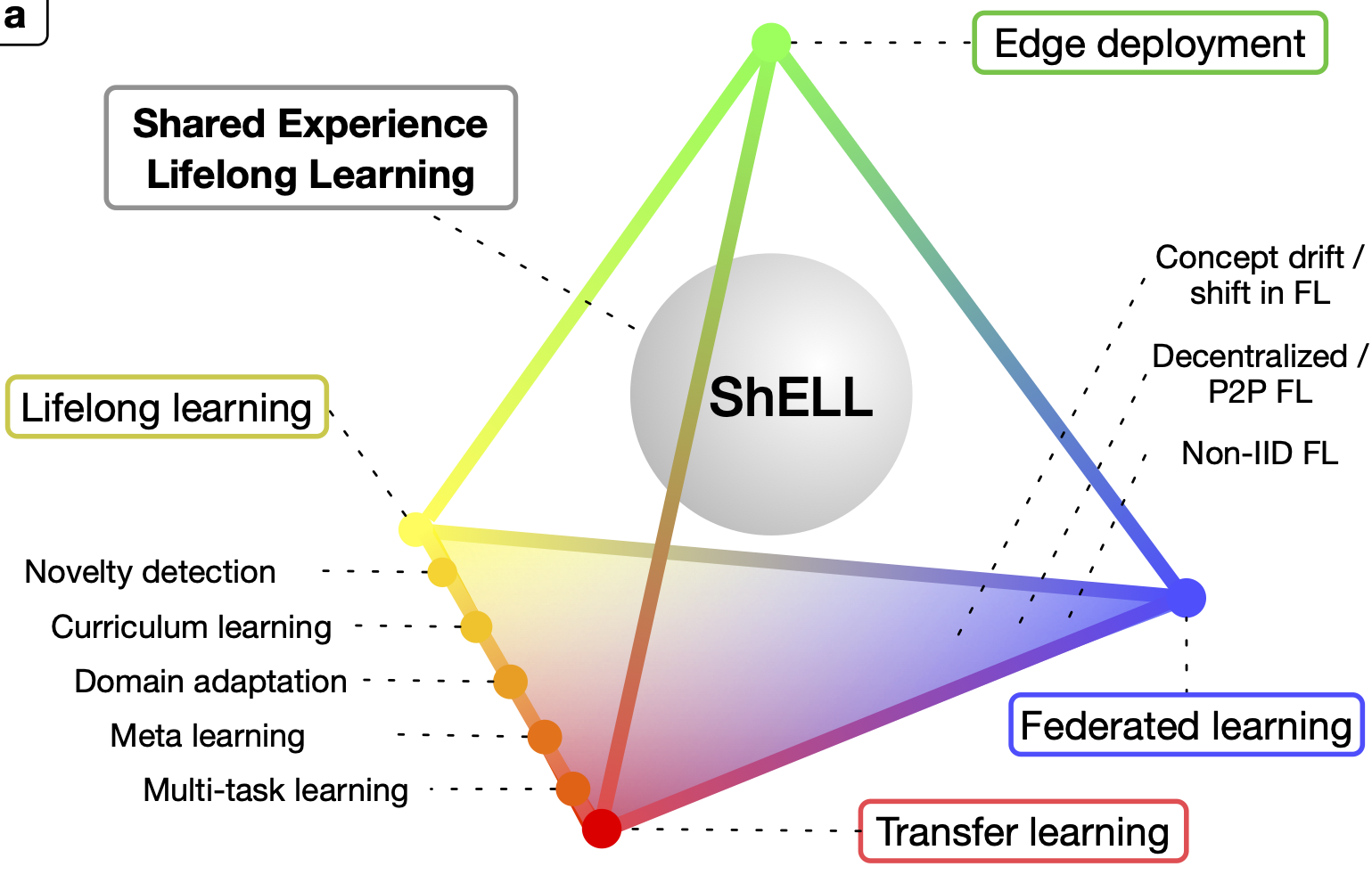
The paper introduces MOSAIC, a new algorithm for collaborative learning among autonomous, agentic AI systems that operate in decentralized, dynamic environments. These agents selectively share and reuse modular knowledge (in the form of neural network masks) without requiring synchronization or centralized control.

Key innovations include:

  • Task similarity via Wasserstein embeddings and cosine similarity to guide knowledge retrieval.
  • Performance-based heuristics to decide what, when, and from whom to learn.
  • Modular composition of knowledge to build better policies.

Experiments show that MOSAIC outperforms isolated learners in speed and performance, sometimes solving tasks that isolated agents cannot. Over time, a form of emergent self-organization occurs between agents, resulting from the discovered hierarchies in the curriculum, where simpler tasks support harder ones, enhancing the collective’s efficiency and adaptability.

Overall, MOSAIC demonstrates that selective, autonomous collaboration can produce a collective intelligence that exceeds the sum of its parts.

The paper: https://arxiv.org/abs/2506.05577
The code: https://github.com/DMIU-ShELL/MOSAIC

Abstract:

Agentic AI has gained significant interest as a research paradigm focused on autonomy, self-directed learning, and long-term reliability of decision making. Real-world agentic systems operate in decentralized settings on a large set of tasks or data distributions with constraints such as limited bandwidth, asynchronous execution, and the absence of a centralized model or even common objectives. We posit that exploiting previously learned skills, task similarities, and communication capabilities in a collective of agentic AI are challenging but essential elements to enabling scalability, open-endedness, and beneficial collaborative learning dynamics. In this paper, we introduce Modular Sharing and Composition in Collective Learning (MOSAIC), an agentic algorithm that allows multiple agents to independently solve different tasks while also identifying, sharing, and reusing useful machine-learned knowledge, without coordination, synchronization, or centralized control. MOSAIC combines three mechanisms: (1) modular policy composition via neural network masks, (2) cosine similarity estimation using Wasserstein embeddings for knowledge selection, and (3) asynchronous communication and policy integration. Results on a set of RL benchmarks show that MOSAIC has a greater sample efficiency than isolated learners, i.e., it learns significantly faster, and in some cases, finds solutions to tasks that cannot be solved by isolated learners. The collaborative learning and sharing dynamics are also observed to result in the emergence of ideal curricula of tasks, from easy to hard. These findings support the case for collaborative learning in agentic systems to achieve better and continuously evolving performance both at the individual and collective levels.
1 Research associate and 2 funded PhD. positions on the evolution of neural learning and plasticity

One research associate and two funded Ph.D. positions are available at the Computer Science Department, School of Science, Loughborough University, UK, on the topics of the evolution of lifelong learning in neural networks.

Research.  The aim is to develop new neuroevolution algorithms for lifelong learning. The objectives are to devise machine learning systems that autonomously adapt to changing conditions such as variation of the data distribution, variation of the problem domain or parameters, with minimal human intervention. The approach will use neuroevolution, neuromodulation, and other methodologies to continuously discover and update learning strategies, implement selective plasticity, and achieve continual learning.

For an overview of the research direction, see the paper: Born to Learn: the Inspiration, Progress and Future of Evolved Plastic Artificial Neural Networks https://www.researchgate.net/publication/315710249_Born_to_Learn_the_Inspiration_Progress_and_Future_of_Evolved_Plastic_Artificial_Neural_Networks

Application areas include a variety of automation and machine learning problems, e.g. vision, control, and robotics, with a particular focus on resilience and autonomy.


Working environment. 
The research associate and Ph.D. students, based at the Computer Science Department, will work in an international team with opportunities for collaboration and travel. They will have access to a number of robotic platforms such as mobile and flying robots, manufacturing robots, High Performance Computing clusters, and GPU computing. The Computer Science Department and robotics laboratories have ongoing collaborations with large industries and programs to promote start-ups.

Loughborough University is ranked 7th in the UK in the 2019 League Table Ranking  http://www.thecompleteuniversityguide.co.uk/loughborough/performance ), and is located in Loughborough, a town well connected to London by a 1h20m journey by train.


Requirements.

Postdoc: A Ph.D. in Computer Science or related with a strong publication record, coding abilities, predisposition to work in a team and independence, passion for science, solid work ethics.

Ph.D. students: The ideal candidate holds (or is about to obtain) a first-class honour undergraduate/postgraduate degree (or equivalent) in Computer Science, Mathematics, Statistics, Electrical or Electronic Engineering, or has authored publications in recognised conferences/journals. Independent working skills are valued as well as the capability of working in a team. Collegiality and interpersonal skills are essential.

Excellent English language skills are also essential (see requirements here http://www.lboro.ac.uk/international/englang/index.htm)


Period and salaries. 

Postdoc position: until June 2020 (with possible extension) with a competitive salary at Grade 6 (http://www.lboro.ac.uk/services/hr/benefits/pay-rewards/)

Start: as soon as possible.

Ph.D. studentships:

Scholarship: £14,777 per annum plus tuition fees at the UK/EU rate.

Start: August 2018 or shortly after.

Duration: 3 years.


Enquiries and applications. Interested candidates are invited to send preliminary enquiries to a.soltoggio@lboro.ac.uk including a CV, a university transcript of marks, a list of references, and a statement of about 300 words motivating their interest in this area of research.

Deploying AI and deep learning to product apps

This is one just advertising video of the potential of the technology that we developed at Loughborough University in collaboration with ICE

Frontiers in Neurorobotics : special issue

I’m happy that I finally managed to put together a research topic for Frontiers in Neurorobotics.

http://www.frontiersin.org/Neurorobotics/researchtopics/Neural_plasticity_for_rich_and/3107

Deadline for abstract submission (12 September 2014)

Deadline for paper submission (12 January 2015)

If you are interested in contributing, please send me  short email or visit the link above to submit an abstract

Short-term plasticity as hypothesis testing in distal reward learning

I submitted today my latest manuscript titled “Short-term plasticity as hypothesis testing in distal reward learning”. The manuscript is currently under peer review.

The Matlab code to reproduce the experiment is available here for download.

Update (4 April 2014)

A new version of the paper was submitted for review. Here is the updated Matlab code.