
Tag Archives: Machine Learning

Collaborative Learning in Agentic Systems: A Collective AI is Greater Than the Sum of Its Parts

The paper introduces MOSAIC, a new algorithm for collaborative learning among autonomous, agentic AI systems that operate in decentralized, dynamic environments. These agents selectively share and reuse modular knowledge (in the form of neural network masks) without requiring synchronization or centralized control.

Key innovations include:

  • Task similarity via Wasserstein embeddings and cosine similarity to guide knowledge retrieval.
  • Performance-based heuristics to decide what, when, and from whom to learn.
  • Modular composition of knowledge to build better policies.

Experiments show that MOSAIC outperforms isolated learners in speed and performance, sometimes solving tasks that isolated agents cannot. Over time, a form of emergent self-organization occurs between agents, resulting from the discovered hierarchies in the curriculum, where simpler tasks support harder ones, enhancing the collective’s efficiency and adaptability.

Overall, MOSAIC demonstrates that selective, autonomous collaboration can produce a collective intelligence that exceeds the sum of its parts.

The paper: https://arxiv.org/abs/2506.05577
The code: https://github.com/DMIU-ShELL/MOSAIC

Abstract:

Agentic AI has gained significant interest as a research paradigm focused on autonomy, self-directed learning, and long-term reliability of decision making. Real-world agentic systems operate in decentralized settings on a large set of tasks or data distributions with constraints such as limited bandwidth, asynchronous execution, and the absence of a centralized model or even common objectives. We posit that exploiting previously learned skills, task similarities, and communication capabilities in a collective of agentic AI are challenging but essential elements to enabling scalability, open-endedness, and beneficial collaborative learning dynamics. In this paper, we introduce Modular Sharing and Composition in Collective Learning (MOSAIC), an agentic algorithm that allows multiple agents to independently solve different tasks while also identifying, sharing, and reusing useful machine-learned knowledge, without coordination, synchronization, or centralized control. MOSAIC combines three mechanisms: (1) modular policy composition via neural network masks, (2) cosine similarity estimation using Wasserstein embeddings for knowledge selection, and (3) asynchronous communication and policy integration. Results on a set of RL benchmarks show that MOSAIC has a greater sample efficiency than isolated learners, i.e., it learns significantly faster, and in some cases, finds solutions to tasks that cannot be solved by isolated learners. The collaborative learning and sharing dynamics are also observed to result in the emergence of ideal curricula of tasks, from easy to hard. These findings support the case for collaborative learning in agentic systems to achieve better and continuously evolving performance both at the individual and collective levels.
Ph.D. positions in lifelong learning and neuromorphic AI/ML at Loughborough University

We would like to invite candidates to apply for funded Ph.D. positions in AI and ML at the Computer Science Department at Loughborough University.

Topics of interest involve AI/ML areas such as lifelong learning, bio-inspired neural computation and spiking neural networks with a particular focus on applications in reinforcement learning, robotics, and edge-AI.

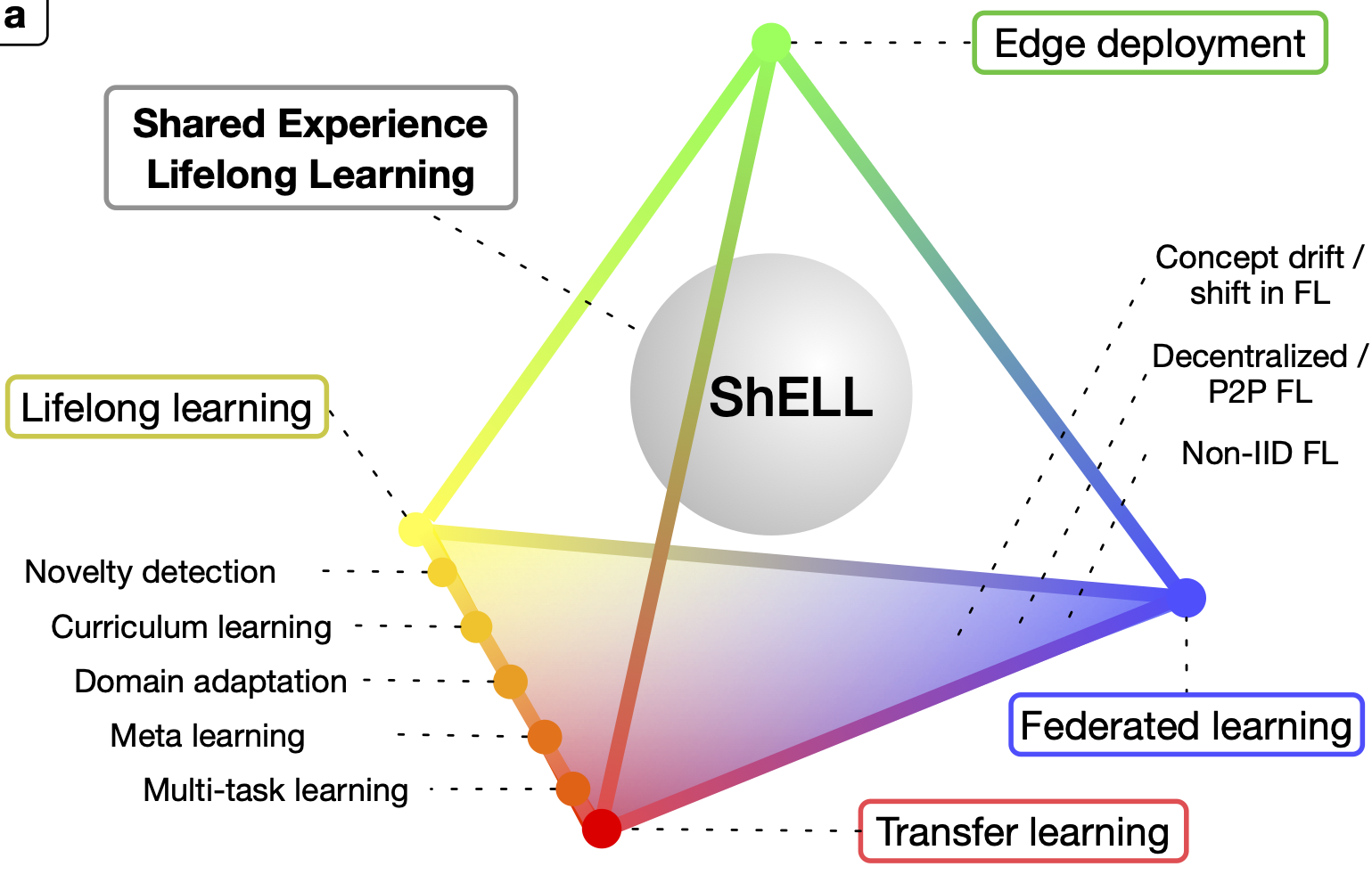
Details.This new field of AI seeks to create machines that learn during a lifetime similarly to biological brains. This research continues and advances recent progress from the DARPA projects Lifelong Learning Machines (L2M) and Shared Experience Lifelong Learning (ShELL). The candidates will join a growing research group of Ph.D. students and postdocs working in the same area, and have access to the latest computational devices such as Nvidia A100 cards. Collaboration opportunities with world-leading AI laboratories will be encouraged and supported. Different projects will focus on aspects such as multi-agent neural reinforcement learning, neuromodulation, continual learning, low-power edge-computing, neuromorphic algorithms and implementations. Applications areas include autonomous vehicles and agents, advanced industrial systems, drones and other distributed robotic systems.

Further additional  links to our latest news and papers:
https://www.azorobotics.com/News.aspx?newsID=12518

https://openreview.net/forum?id=BJge3TNKwH

https://arxiv.org/abs/1703.10371

https://www.frontiersin.org/articles/10.3389/fncom.2021.666131/full

https://ieeexplore.ieee.org/abstract/document/9534283


Loughborough University. Loughborough University is a top-ten rated university in England for research intensity (REF2014). In choosing Loughborough for your research, you’ll work alongside academics who are leaders in their field. You will benefit from comprehensive support and guidance from our Graduate School, including tailored careers advice, to help you succeed in your research and future career.

Entry requirements. Applicants should have, or expect to achieve, at least a 2:1 Honours degree (or equivalent) in computer science or a related subject. A relevant Master’s degree and/or experience in one or more of the following will be an advantage: artificial intelligence, neural networks, robotics.

Funding information. Please note that studentships will be awarded on a competitive basis to applicants who have applied to this project and other advertised projects within the School. Funding decisions will not be confirmed until early 2022. The studentship is for 3 years and provides a tax-free stipend of £15,609 per annum for the duration of the studentship plus tuition fees at the UK rate.  International (including EU) students may apply however the total value of the studentship will cover the International Tuition Fee Only.

The position will be starting in October 2022 under the supervision of Dr. Andrea Soltoggio and Dr. Shirin Dora. If interested, please get in touch by emailing a.soltoggio@lboro.ac.uk or s.dora@lboro.ac.uk .

Sincerely,

Andrea Soltoggio and Shirin Dora