Author Archives: Andrea

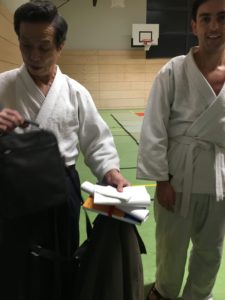
Handing my scientific study to Aikido legend Asai Sensei

Finally,  last week end I managed to hand a copy of my study

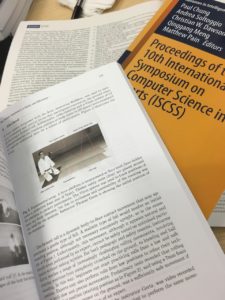
“The Aikido inspiration to safety and efficiency: an investigation on forward roll impact forces”

Soltoggio, Andrea, et al. “The Aikido inspiration to safety and efficiency: an investigation on forward roll impact forces.” Proceedings of the 10th International Symposium on Computer Science in Sports (ISCSS). Springer International Publishing, 2016.

to Aikido legend Katsuaki Asai Sensei in Bielefeld, Germany.

 

From the left: Andrea Soltoggio, Asai Sensei, and Thomas Gertz Asai Sensei receives the volume with the scientific study  The volume with the study

The study, inspired by the Aikido techniques of Asai, demonstrates how Aikido techniques can drastically reduce impact forces when simulating a fall. During the study, participants were invited to perform a forward roll over a sensitive force platform embedded in the floor in the laboratory of Neurocognition and Action of Prof. Thomas Schack at Bielefeld University.  Under the supervision of Aikido 3rd Dan Thomas Gertz of Aikikai Deutschland, two different groups were compared. One group had never trained Aikido, while a second group had between 1 to 10+ years of Aikido experience. The measurements showed that untrained subjects, while rolling from a kneeling position very low near the ground, in some cases could experience over 4 times their body weight in vertical forces. On the contrary, trained subjects appeared to be capable of decreasing such forces to values in some cases just over 1 body weight. Surprisingly, further measurements showed that trained subjects, when ‘falling’ from a standing position, recorded lower impact forces on the ground than untrained subjects ‘falling’ from a kneeling position.

Thomas Gertz shows the picture of Asai Sensei performing a forward roll, next to his own demonstration of the movements at the laboratory of Neocognition and Action at Bielefeld University.

I would like to thank all the people that believed in this work and helped me to perform all the steps that lead to this publication: my co-authors in the first place that contributed significantly to set up the experiments, all my Aikido friends, in particular  Thomas Gertz for his supervision, Silvia Fränkel and Nico Ludike, and all the volunteers that took part in the experiments.
Fully funded PhD position in: Machine learning in multi-variate data processing / integration and analysis for clinical diagnostics and prognostics

Fully funded PhD position in: Machine learning in multi-variate data processing / integration and analysis for clinical diagnostics and prognostics

A fully funded PhD position is available in a multi-disciplinary project between the School of Science and the School of Business and Economics, Loughborough University, UK, on the topic of machine learning in multi-variate data processing / integration and analysis for clinical diagnostics and prognostics.

Loughborough University is ranked 11th in the 2016 UK League Table Ranking (http://www.thecompleteuniversityguide.co.uk/loughborough/performance , and is located in Loughborough, a town well connected to London by a 1h20m journey by train.

Research. The application of advanced analytical techniques to the discovery and implementation of human-borne Chemical, Biological, Radiological and Nuclear (CBRN) markers of interest requires large numbers of samples taken from a highly variable sampled population. Efficient progress in this enterprise is limited by the current limits on the speed and sophistication of the data processing and multivariate analysis of the analytical system outputs. This studentship will start the exploration of the boundary between advanced analytical science (sensory capability) and machine learning, including neural and deep learning. It will be part of what is intended to be an enduring collaboration between researchers in Chemistry, Computer Science, Mathematics and Information Science. The supervisory team is composed of Dr. Andrea Soltoggio, expert in Artificial Intelligence and Neural Learning, and Dr. Martin Sykora, expert in Machine Learning, Data Mining and Big Data. The academic team supporting this project will include:

Prof. C. L. Paul Thomas Chemistry, markers and detection

Prof. Tom Jackson, Centre for Information Management, applied and theory based knowledge management

Dr. Iain Phillips, Department of Computer Science, computer networks and high performance computing

Dr. Eugenie Hunsicker, Department of Mathematics, statistical techniques

Working environment. The student, based at the Computer Science Department http://www.cs.lboro.ac.uk, School of Science, will work and collaborate with diverse research groups: the Center for Analytical Science (Chemistry Department) with access to research of the Toxi-triage H2020 project (http://cordis.europa.eu/project/rcn/194860_en.html)), and the Center for Information Management (CIM) http://www.lboro.ac.uk/research/cim/. Loughborough University offers cutting-edge computing capabilities with a Hydra High Performance Computing cluster, a 1956-core 64-bit Intel Xeon cluster supplied by Bull, and GPUs computing capabilities.

Requirements. The ideal candidate holds (or is about to obtain) a first-class honour undergraduate/postgraduate degree (or equivalent) in Computer Science, Mathematics, Statistics, Electrical or Electronic Engineering, or has authored publications in recognised conferences/journals. Independent working skills are valued as well as the capability of working in a team. Collegiality and interpersonal skills are essential. Excellent English language skills are highly desired (see requirements here http://www.lboro.ac.uk/international/englang/index.htm)

Period/Scholarship.

Start: January 2016.

Duration: 3 years.

Scholarship: £14,057 per annum plus tuition fees at the UK/EU rate (currently £4,052 p.a.)

Application deadline: 16 November 2015.

Enquiries and applications.

Informal enquiries are encouraged and to be addressed to Dr. Andrea Soltoggio (a.soltoggio@lboro.ac.uk). Interested candidates are invited to submit an application at http://www.lboro.ac.uk/study/apply/research/including a CV, the names and addresses of two referees, and a statement of research interest (maximum 300 words).

Fully funded PhD position in Neural Learning / Robotics / Evolutionary Neural Networks

A fully funded PhD position is available at the Computer Science Department, School of Science, Loughborough University, UK, on the topics of Neural Learning / Robotics / Evolutionary Neural Networks.

Loughborough University is ranked 11th in the 2016 UK League Table Ranking (http://www.thecompleteuniversityguide.co.uk/loughborough/performance , and is located in Loughborough, a town well connected to London by a 1h20m journey by train.

Research.The focus is on developing new neural learning algorithms with possible applications to a variety of automation and machine learning problems, e.g. vision, robotics, autonomous vehicles, manufacturing technology. We seek an outstanding candidate, capable of defining their own research project and bringing novel ideas and initiatives to the lab.

Working environment. The student, based at the Computer Science Department, School of Science, will have access to a number of robotic platforms, from humanoid robots, to UAVs and a number of industrial and service robots, as well as a High Performance Computing cluster and GPUs. Research is conducted with the Intelligent Interactive System Division in the department of Computer Science, but also within the cross-department interest group on Deep Automation, Learning and Evolution. The group has access to laboratories across campus including the Intelligent Automation Lab (Mechanical and Manufacturing Engineering), research groups in Aeronautical and Automotive Engineering, and the Centre for Information Management. The department collaborates with leading national and international industrial partners.

Requirements. The ideal candidate holds (or is about to obtain) a first-class honour undergraduate/postgraduate degree (or equivalent) in Computer Science, Mathematics, Statistics, Electrical or Electronic Engineering, or has authored publications in recognised conferences/journals. Independent working skills are valued as well as the capability of working in a team. Collegiality and interpersonal skills are essential. Excellent English language skills are highly desired (see requirements here http://www.lboro.ac.uk/international/englang/index.htm)

Period/Scholarship.

Start: October 2015.
Duration: 3 years.
Scholarship: £14,057 per annum plus tuition fees at the UK/EU rate (currently £4,052 p.a.)
Application deadline: 12 July.

Enquiries and applications. Interested candidates are invited to establish a preliminary contact with me (a.soltoggio@lboro.ac.uk), possibly including a CV, the names and addresses of two referees, and a statement of research interest (maximum 300 words), before submitting the full application at http://www.lboro.ac.uk/study/apply/research/

Frontiers in Neurorobotics : special issue

I’m happy that I finally managed to put together a research topic for Frontiers in Neurorobotics.

http://www.frontiersin.org/Neurorobotics/researchtopics/Neural_plasticity_for_rich_and/3107

Deadline for abstract submission (12 September 2014)

Deadline for paper submission (12 January 2015)

If you are interested in contributing, please send me  short email or visit the link above to submit an abstract

Short-term plasticity as hypothesis testing in distal reward learning

I submitted today my latest manuscript titled “Short-term plasticity as hypothesis testing in distal reward learning”. The manuscript is currently under peer review.

The Matlab code to reproduce the experiment is available here for download.

Update (4 April 2014)

A new version of the paper was submitted for review. Here is the updated Matlab code.

Brain Waves Create Archives of Experience and Expectation

This article

@article{harmelech2013JNeuroscience,
Title = {The Day-After Effect: Long Term, Hebbian-Like Restructuring of Resting-State fMRI Patterns Induced by a Single Epoch of Cortical Activation},
Author = {Harmelech, Tai and Preminger, Son and Wertmam, Eliahu and Malach, Rafael},
Journal = {Journal of Neuroscience},
Month = {May},
Number = {22},
Pages = {9488-9497},
Volume = {33},
Year = {2013},
Bdsk-Url-1 = {http://dx.doi.org/10.1523/JNEUROSCI.5911-12.2013}
}

featured at
http://wis-wander.weizmann.ac.il/past-brain-activation-revealed-in-scans#.Uc1PHj6OC1m
and
http://www.psychologytoday.com/blog/the-athletes-way/201306/brain-waves-create-archives-experience-and-expectation
strongly suggests the existence of long-lasting eligibility traces. The reverberating activity is observed to last up to 24 hours, a significantly longer time span in comparison to the few seconds time constant of the chemical traces  I’ve  modelled in my recent papers:

http://www.mitpressjournals.org/doi/abs/10.1162/NECO_a_00419 and

http://www.frontiersin.org/Neurorobotics/10.3389/fnbot.2013.00006/full

Reverberating activity could in effect be a higher order type of trace, and  could prove fundamental in the solution of distal reward problems and learning.


Rarely Correlating Hebbian Plasticity

(1) Andrea Soltoggio and Jochen Steil, Solving the Distal Reward Problem with Rare Correlations, Neural Computation, 25, p940-978. 2013 http://www.mitpressjournals.org/doi/abs/10.1162/NECO_a_00419

How do animals establish associations between cues, actions and rewards when rewards come sometime later after the actions that caused them?

The research in the paper “Solving the Distal Reward Problem with Rare Correlations”(1) proposes a new type of computation based on the rarity of correlations. Some neural events that happen rarely are selected to leave a trace which can be detected later in time when a reward occurs. The study shows how the neural models is capable of classical and operant conditioning with delayed rewards.

The PDF of the paper is available for download.  Support material include the Matlab code to reproduce the experiments and a short video.

Download PDF of Solving the Distal Reward Problem with Rare Correlations

Download the Matlab code and support video


How the idea came about

The main idea was inspired by the work of E. Izhikevich who, in 2007, published a computational model to solve the distal reward problem using neuromodulation, eligibility traces and spiking neurons with STDP. At that point I had been working more than two years on neuromodulation and reward-based learning. Izhikevich’s work was really inspirational, but in contrast to his position, it was soon clear to me that spiking neurons were not crucial and that something else was driving the learning. This thought hung in the back of my mind for a few years until,  in the summer of 2011, I met Paul Tonelli, a young researcher working on the evolution of plasticity and learning. We discussed the topic of the distal reward learning in the noisy setting of a Dublin’s pub. The suspicion that rare events (or correlations) were a pivotal part of the learning led me to prove it. A week later I had the first version of the algorithm. All simulations and paper were ready in December 2011. Then the long negotiations with the reviewers started and the paper is schedule appear in April 2013 in Neural Computation.

Talk: understanding and modelling movements

Date: Tue, 29/05/2012 – 14:00 – 15:00
Location: Bielefeld University, Q2-101

Title:
Understanding and modelling movements; an overview and specific approaches
Abstract:
The movements of vertebrates animals inspire us with stunning complexity and beauty. Yet our understanding of the underlying mechanisms are limited. The topic is introduced with an overview of current models and hypotheses. In particular, the concepts of primitives, composition, co-articulation and decomposition are discussed. Following, specific approaches to modelling stability, learning and movement decomposition are presented. The speakers intend to encourage a discussion over the biological significance and implications of current models.
Speakers:
Andrea Soltoggio, Klaus Neumann and Andre Lemme